- Home /
- Shop /
- Lineatus Fairy Wrasse

Lineatus Fairy Wrasse
Lineatus Fairy Wrasse
Low stock
Couldn't load pickup availability
Description
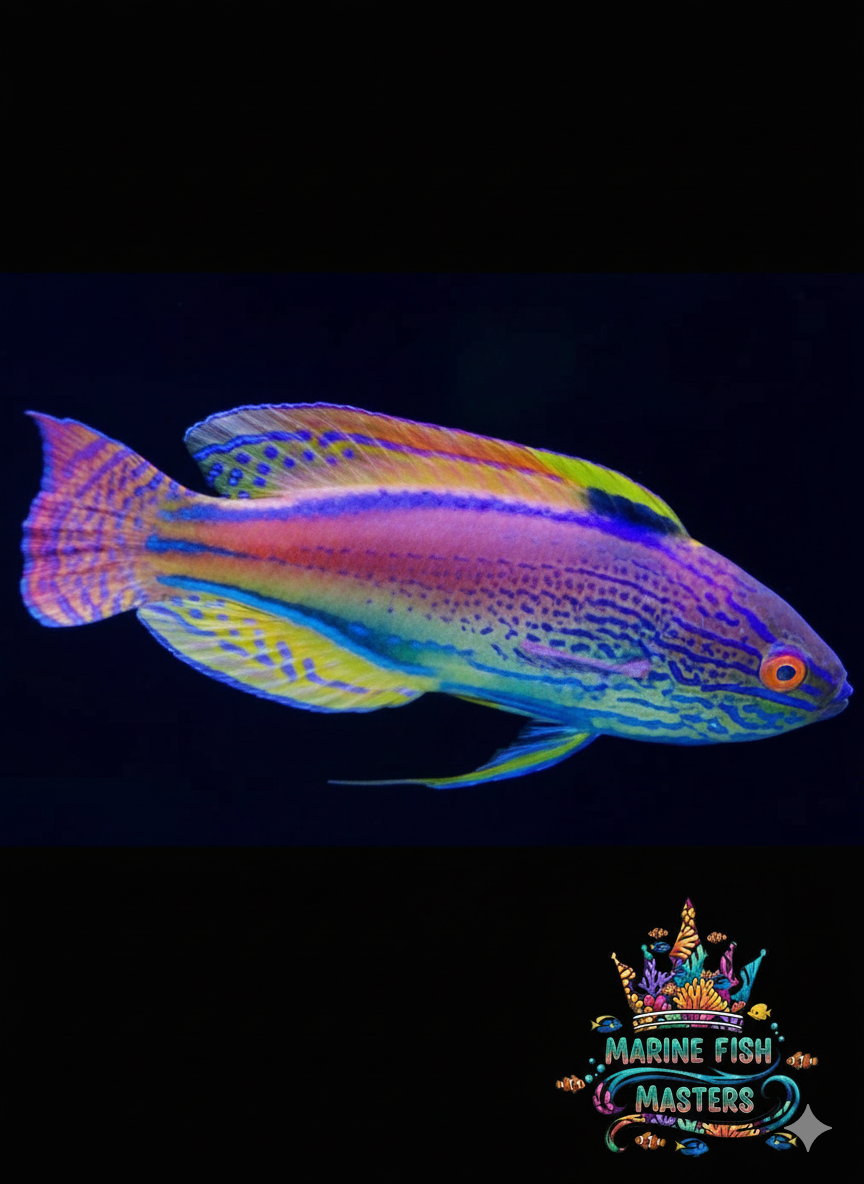
The Lineatus Fairy Wrasse, also known by its scientific name, Cirrhilabrus lineatus, is a highly coveted and visually stunning member of the Fairy Wrasse family. Renowned for its brilliant and intricate coloration, it is a peaceful, active addition to a well-established marine aquarium.
Appearance:
Male Lineatus Fairy Wrasses are spectacular, displaying a beautiful coloration that includes a light purple to bluish body adorned with thin, horizontal blue lines on the head and body. These lines often transition to spots toward the tail. The dorsal, anal, and caudal (tail) fins feature striking thin orange to yellow stripes and are bordered in blue. Females and sub-dominant males exhibit more subdued but similar coloring, often featuring multiple blue horizontal lines that break into spots towards the tail. As with many species in this genus, this fish is a protogynous hermaphrodite, meaning a female or juvenile can transition into a dominant male if the environmental conditions are right (i.e., if it is the only fish of its species present).
Temperament and Habitat:
This wrasse is generally peaceful and is considered reef-safe, meaning it will not typically bother corals or invertebrates. It is an active fish, constantly swimming and foraging throughout the rockwork, adding both color and motion to the tank. They originate from the clear outer reef slopes of the Western Central Pacific, including the Great Barrier Reef, the Coral Sea, and New Caledonia, inhabiting depths up to 55 meters.
Care Information
Aquarium Requirements
- Minimum Tank Size: A minimum of 90 gallons is recommended to provide ample swimming space and stable water conditions for this active fish.
- Aquascaping: The aquarium must feature plenty of live rock with numerous crevices, caves, and overhangs. These structures serve as essential hiding spots and resting places, especially at night when the wrasse will often retreat into the rockwork or substrate.
- Lid Requirement: This species is a skilled jumper. A tightly fitting lid or canopy is absolutely essential to prevent the fish from escaping the aquarium.
Water Parameters
|
Parameter |
Recommended Range |
|
Temperature |
72–78° F (22–26° C) |
|
Salinity |
1.020–1.025 specific gravity (sg) |
|
pH |
8.1–8.4 |
|
Alkalinity (dKH) |
8–12 dKH |
Diet and Feeding
- Diet Type: Carnivore/Meaty Foods.
- Feeding Schedule: Due to their high metabolism and active nature, it is recommended to feed the Lineatus Fairy Wrasse multiple times a day.
-
Recommended Foods: A varied diet is crucial for their long-term health and vibrant coloration. Offer high-quality meaty foods, such as:
- Vitamin-enriched frozen Mysis shrimp.
- Vitamin-enriched frozen brine shrimp.
- Other prepared marine meaty foods.
- High-quality marine flakes and pellets.
- Occasionally offer Nori seaweed for variety.
Compatibility
- General: The Lineatus Fairy Wrasse is a peaceful fish that coexists well with most other community marine fish and is an ideal candidate for a reef system.
- Grouping: They can be kept in small groups (harems) consisting of one male and several females, though it is often safer to add the entire group at the same time to reduce aggression. If adding one individual, it should typically be one of the last fish introduced to the display tank to prevent harassment from more established tankmates. Avoid keeping multiple male Fairy Wrasses together in a confined space.
-
Invertebrates: They are considered reef-safe and will not harm soft or stony corals. While generally safe with most ornamental invertebrates, caution is always advised as they are known to occasionally pick at very small crustaceans.
Specifications
| Specification | Details |
|---|---|
| Common Name | Lineatus Fairy Wrasse, Purplelined Wrasse |
| Scientific Name | Cirrhilabrus lineatus |
| Origin | Western Central Pacific (Great Barrier Reef, Coral Sea, New Caledonia) |
| Family | Labridae (Wrasse) |
| Maximum Adult Size | Up to 5 inches (12.7 cm) |
| Reef Compatibility | Excellent (Reef Safe) |
| Temperament | Peaceful |
| Care Level | Easy to Moderate |