- Home /
- Shop /
- Passer Angelfish (King Angelfish)

Passer Angelfish (King Angelfish)
Passer Angelfish (King Angelfish)
Regular price
$47.00
Regular price
Sale price
$47.00
Low stock
Quantity
Couldn't load pickup availability
Description
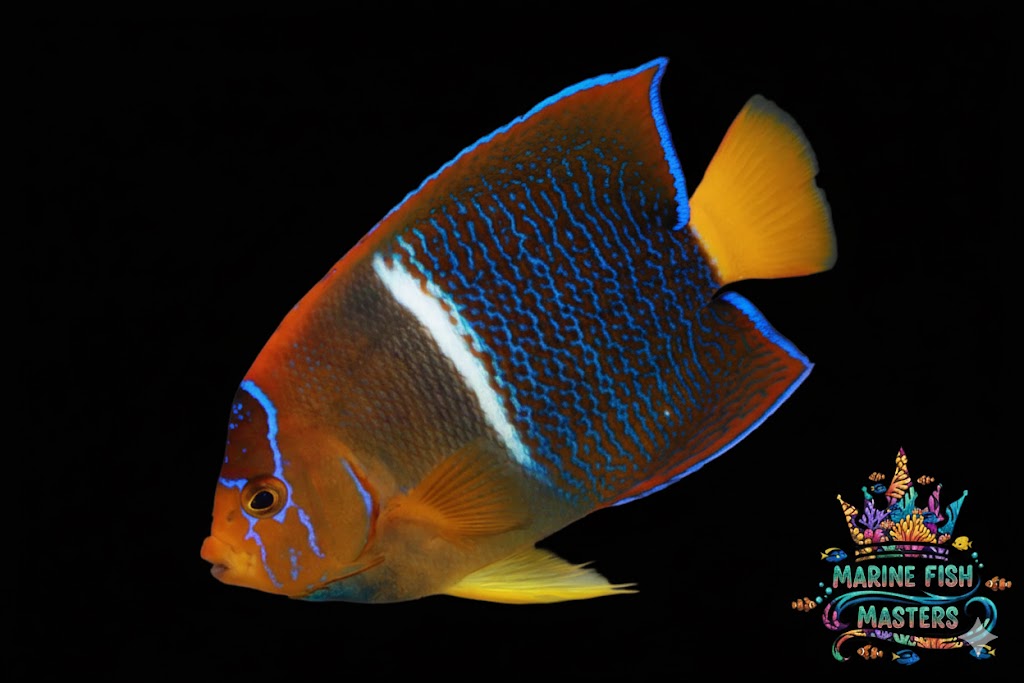
The Passer Angelfish, also known as the King Angelfish or Whitebanded Angelfish, is a striking and hardy species from the Holacanthus genus, native to the Eastern Pacific Ocean. This fish undergoes a dramatic and beautiful color transformation as it matures.
- Juvenile Appearance: Juveniles feature a vibrant, orange-brown body with multiple thin, vertical blue stripes and a single prominent, thick white vertical band. Their caudal (tail) and other fins are often outlined in electric blue and bright yellow.
- Adult Appearance: As they grow, their body color changes to a deep, dark slate blue, sometimes mottled with gray. The distinctive feature is a bold, white vertical band that remains just behind the pectoral fin. The caudal fin is a striking yellow, and the dorsal and anal fins are often edged in electric blue.
- Size: This is a large marine angelfish, reaching a significant size of up to 14 inches (35 cm) in a home aquarium.
Care Information
- Aquarium Setup: Due to its large adult size and active nature, the Passer Angelfish requires a spacious, well-established aquarium. A minimum tank size of 220-250 gallons is recommended to provide ample swimming room and to mitigate potential aggression. The tank should be decorated with plenty of live rock to create caves, crevices, and hiding spots, which are essential for its security and natural grazing behavior.
-
Water Parameters: Maintain high water quality with stable conditions.
- Temperature: 72–78°F (22–26°C)
- pH: 8.1–8.4
- Specific Gravity (Salinity): 1.020–1.025
-
Diet and Feeding: As an omnivore, a varied and high-quality diet is crucial for long-term health. Feed small amounts at least three times daily to mimic their natural grazing habits.
- Include vegetable matter such as high-quality marine algae, Spirulina, and Nori sheets (using a vegetable clip).
- Offer meaty foods like mysis shrimp, enriched frozen brine shrimp, and chopped seafood.
- Supplement the diet with foods specially formulated for marine angelfish, which often contain sponge material, as this is a significant part of their wild diet.
-
Temperament and Tank Mates: The Passer Angelfish is generally considered semi-aggressive and should be housed with other robust, semi-aggressive fish that can hold their own, such as Tangs, larger Wrasses, and Triggerfish.
- They are territorial, especially towards other angelfish, particularly those from the Holacanthus genus or fish with similar size and shape. It is generally best to keep only one per aquarium unless the tank is extremely large (over 400 gallons) and they are introduced simultaneously or as a mated pair.
- Handle with care, as angelfish possess a sharp cheek spine that can snag nets or cause injury.
- Reef Compatibility: Due to its natural diet, the Passer Angelfish is not recommended for reef aquariums. It will likely graze on soft and stony coral polyps, sessile invertebrates, and clam mantles. It is best suited for a Fish-Only or Fish-Only-With-Live-Rock (FOWLR) setup.
Specifications
| Specification | Details |
|---|---|
| Scientific Name | Holacanthus passer |
| Other Common Names | King Angelfish, Whitebanded Angelfish |
| Origin | Eastern Pacific Ocean (Gulf of California to Peru, including the Galapagos Islands) |
| Maximum Size | Up to 14 inches (35 cm) |
| Minimum Aquarium Size | 220–250+ gallons for a single adult |
| Care Level | Moderate to Intermediate |
| Temperament | Semi-Aggressive |
| Reef Compatibility | Generally Not Reef Safe (Will nip at soft and stony corals, clam mantles, and sessile invertebrates) |
| Diet | Omnivore (Feeds heavily on sponges, algae, and invertebrates in the wild) |
| Family | Pomacanthidae |